AI Scams Are Getting Scary: How to Protect Yourself
Scams used to be easy to spot. Broken English, strange email addresses, a prince who needed your help moving money. Those days are fading. AI now lets scammers write flawless messages, clone voices, fake faces on video calls, and personalize attacks at a scale that was never possible before.
The scary part isn't that scams exist. It's that the old warning signs no longer work.
What Has Changed
Traditional scams relied on volume. Send a million clumsy messages and hope a few people fall for it. AI changes the economics in three ways:
- Quality. Messages are polished, fluent, and free of the typos we learned to look for.
- Personalization. AI can scan public information, such as social media posts, job titles, and company news, and craft messages that feel tailor-made.
- Scale and speed. One scammer can now run hundreds of convincing conversations at once.
The result: attacks that look and sound like someone you trust.
The Most Common AI-Powered Scams
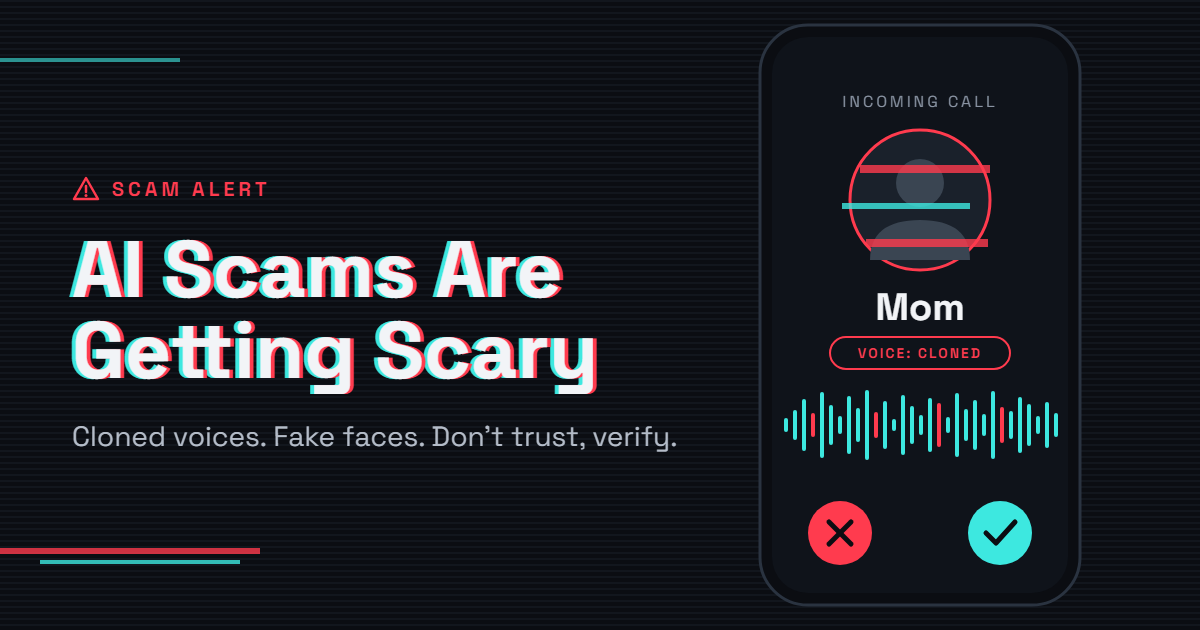
1. Voice cloning scams. With just a short audio sample, often taken from a social media video, scammers can imitate a person's voice. A typical attack is a call from a "family member" in trouble: a car accident, an arrest, a kidnapping. The voice sounds right, the panic feels real, and the demand is always urgent money.
2. Fake CEO and boss scams. An employee gets a call, voice note, or even video meeting from someone who looks and sounds like an executive, asking for an urgent payment or sensitive data. Businesses have lost large sums to this kind of fraud.
3. Deepfake video calls. Real-time face-swapping tools can make a scammer appear as someone else on a live call. This is used for impersonating executives, fake job interviews, and romance fraud.
4. Hyper-personalized phishing. Instead of "Dear customer," you get a message that mentions your employer, a recent purchase, or a colleague's name. It feels legitimate because it uses real details.
5. Romance and "pig butchering" scams. AI helps scammers keep up long, emotionally convincing conversations with many victims at once, slowly building trust before steering them toward fake investments.
6. Fake investment and crypto schemes. Deepfake videos of celebrities or public figures "endorsing" a platform, along with AI-generated reviews, fake websites, and fake support chats.
7. Fake customer support. Chatbots that pose as your bank, delivery company, or a tech support agent to extract passwords and one-time codes.
8. Synthetic identities and fake documents. AI-generated IDs, photos, and paperwork used to open accounts, apply for loans, or pass weak verification checks.
Why They Work
These scams succeed because they exploit psychology, not technology:
- Urgency. "Act now or something terrible happens."
- Authority. A boss, a bank, the police.
- Emotion. Fear for a loved one, excitement about a prize, loneliness.
- Familiarity. A voice or face you recognize.
When people panic, they skip verification. AI simply makes the performance more convincing.
Warning Signs That Still Matter
Perfect grammar no longer proves anything, but these signals still help:
- Pressure to act immediately and not tell anyone
- Requests for unusual payment methods, such as gift cards, crypto, or wire transfers
- Requests to move the conversation to a private app
- A "family member" or "boss" contacting you from a new number
- Reluctance to answer questions only the real person would know
- Offers or returns that sound too good to be true
- Slightly odd video behavior, like unnatural blinking, mismatched lip movement, or blurring around the face
How to Protect Yourself
Pause and verify. The single best defense. Hang up and call the person back on a number you already know. Contact the company through its official website or app, never through links or numbers in the message.
Set a family code word. Agree on a secret word or question with close relatives. If someone calls in an emergency, ask for it. A cloned voice won't know it.
Slow down money. Be suspicious of any request for urgent payment. For large transfers, require a second confirmation through a different channel.
Protect your accounts. Use strong, unique passwords and a password manager. Turn on multi-factor authentication, preferably with an authenticator app or a hardware key rather than SMS. Never share one-time codes with anyone, ever.
Limit what you share publicly. Voice clips, family details, and your workplace information all feed scammers. Tighten privacy settings and think before posting.
Be skeptical of celebrity endorsements. If a famous person seems to be promoting an investment, check their official channels. If you can't confirm it there, assume it's fake.
Treat unexpected video calls carefully. If something feels off, ask the person to do something unpredictable, like turning their head sideways or holding up an object, and confirm through another channel.
For Businesses
Companies face the highest stakes and should consider:
- Requiring multi-step approval for payments and changes to bank details
- Call-back verification for any urgent financial request, using known contact details
- Training employees with realistic simulations of deepfake and phishing attacks
- Clear policies that no one, not even the CEO, can bypass verification procedures
- Tighter identity checks for hiring and customer onboarding
What If You've Been Scammed?
- Act fast. Contact your bank or payment provider immediately; speed can sometimes help stop or recover a transfer.
- Secure your accounts. Change passwords and enable multi-factor authentication.
- Report it to your local police, your country's fraud or cybercrime agency, and the platform where it happened.
- Don't be ashamed. These scams fool smart, careful people. Reporting helps protect others.
The Bigger Picture
Technology to detect fakes is improving, and platforms and banks are building better defenses. But detection will always be in a race with generation. The more durable defense is a habit: don't trust, verify.
In a world where voices, faces, and messages can be faked, trust has to come from process, not from how something looks or sounds. The people who stay safe won't be the ones who can spot every fake. They'll be the ones who always check.